Ayla Holiday Homes
Holiday Home Management Platform — Supply Acquisition & Guest Conversion.
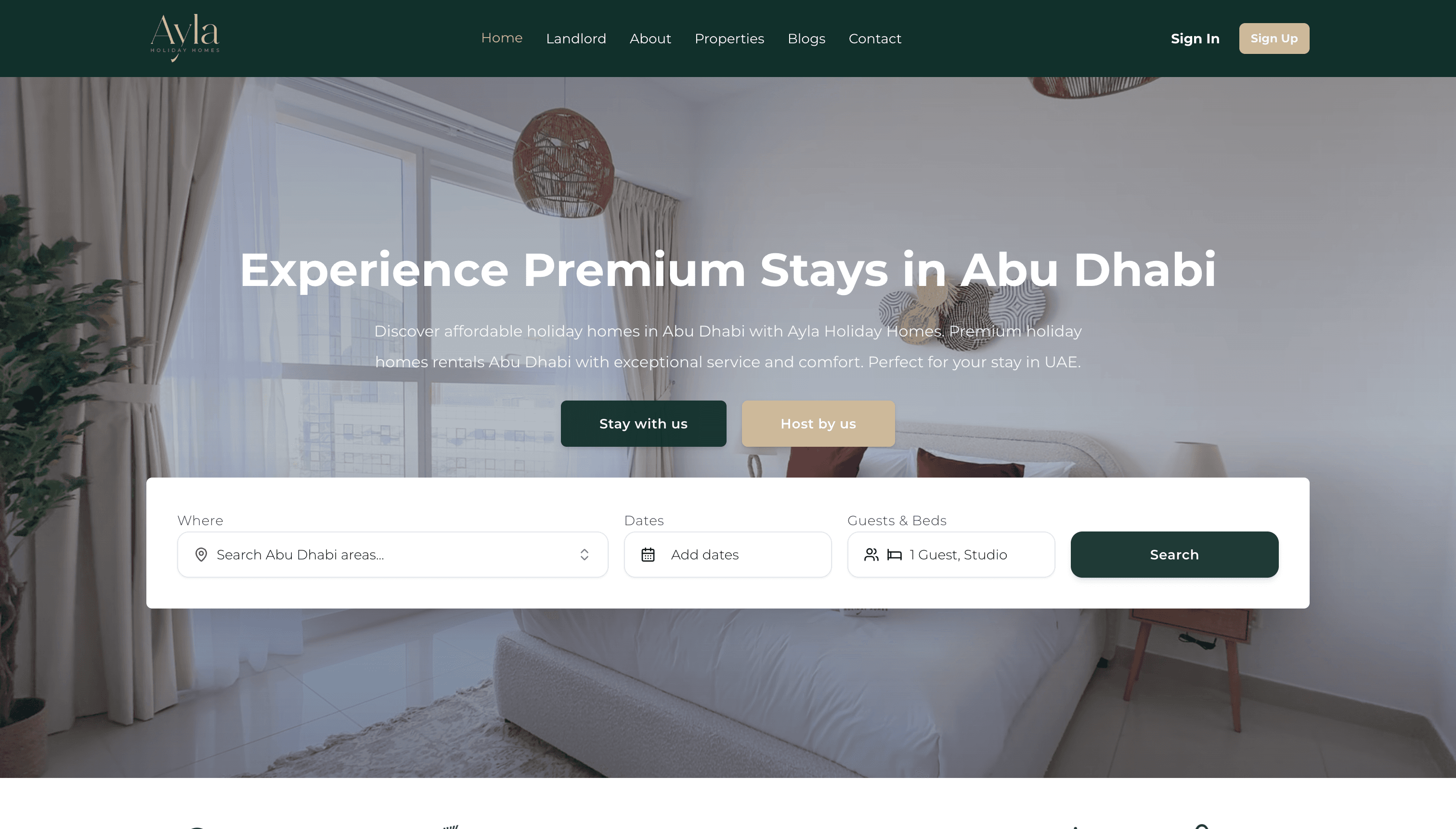
Context
Built the digital operating system for a UAE holiday-home operator entering a market dominated by phone-based inquiries and manual landlord outreach. The platform runs two revenue sides in parallel: a guest-facing discovery and booking channel (search, map, property detail, inquiry, WhatsApp conversion) and an owner acquisition funnel that converts cold landlord interest into context-rich pipeline entries — without a sales call first. Ops runs the full business — listings, destination content, blogs, staff, and a unified lead inbox — without developer involvement on routine changes.
The Challenge
Ayla runs a curated portfolio of furnished holiday homes in Abu Dhabi and was growing — but both sides of the business were invisible online. On the guest side, there was no searchable catalogue, no price transparency, and no way to know which property or channel drove an inquiry; every stay started on WhatsApp or a phone call. On the owner side, onboarding new landlords meant manual cold outreach; owners curious about the management model had to commit to a call before sharing even basic property details. Internally, listings lived in spreadsheets, marketing could not publish without a developer, and inbound leads scattered across shared inboxes with no source tracking. Management could not answer basic pipeline questions — how many landlord leads came from the website versus referrals, which properties had stale enquiries, what the weekly guest inquiry volume was — because there was nowhere to look.
Approach
The strategic choice was to build a conversion engine for both sides of the business, not an OTA clone. An OTA approach would have required live payment infrastructure and competitive listing parity on day one; neither was the right investment for a curated operator with a human-touch close model. Instead, the platform was scoped around two things operators actually need: qualified demand and qualified supply. Guest journey — search, filter, map, property detail, booking intent with real pricing, inquiry and WhatsApp — gets guests to a point of genuine intent before ops follows up. Owner journey — a branded two-step landlord funnel that collects property profile before contact details — turns cold interest into pipeline entries with context already attached. Ops autonomy was a core product requirement, not an afterthought: if the team needed a developer to publish a listing or update a blog, the platform would fail within six months of launch.
Key Decisions
Two revenue funnels on one platform — not an OTA, not a brochure
The positioning decision was to serve both the guest market and the landlord market from one platform without confusing either audience. Guest routes (search, property detail, inquiry) and owner routes (landlord funnel, ROI calculator) are separated by intent — a guest browsing properties never sees owner acquisition content, and vice versa. Each funnel tags its conversions differently so the pipeline review is always split: guest stay intent versus landlord onboarding, by source, without exporting anything.
Owner funnel as supply-side self-service
The landlord funnel was designed around a single insight: owners who submit property details before a call are warmer than owners who just leave a name and number. Step one captures location, bedroom count, and furnished status — the qualification data sales needs. Step two captures contact. The framing as an "ROI Calculator" creates psychological investment before the ask. The result is that sales receives leads with unit context already attached, not a generic inquiry to be chased.
Transparent pricing as trust infrastructure
Full payment integration was out of scope for launch, but price opacity was a guest conversion killer. The booking sidebar computes nightly rate × nights plus cleaning and service fees, validates dates and guest count, and presents a total guests can reason about before making an inquiry. This was a business decision — setting price expectations before the human follow-up reduces the negotiation gap, qualifies intent, and positions the operator as transparent in a market where pricing is often opaque.
Lead attribution as the foundation of pipeline management
Every guest inquiry, owner submission, and contact form writes to one system of record with a source field: Property Inquiry, ROI Calculator Page, Contact Form. Admin exposes search across all fields. This single design decision — one table, one source tag — is what makes weekly pipeline reviews possible. Management can see inquiry volume by property, identify stale leads, and split guest versus owner pipeline without touching a spreadsheet or a shared inbox.
Ops autonomy as a core product requirement
If publishing a listing or updating destination content required a developer, the platform would create a dependency that slows the business down every week. The admin suite was scoped to cover every routine operation: property CRUD with status workflow, rich-text blog publishing, areas and landmarks management, staff roles, and the unified lead inbox. The business manager's team runs the platform day-to-day without engineering involvement. This was treated as a product requirement, not a nice-to-have.
Destination content as dual-audience marketing
Areas and Landmarks are modelled with an audience tag — guest, owner, or all. The same content infrastructure that helps guests discover Abu Dhabi neighbourhoods also serves landlords evaluating whether their property is in a high-demand zone. One CMS, two audiences, one update cycle. This directly addresses the operational problem that many property operators run two separate websites — one for guests, one for owners — that drift out of sync and multiply the editorial workload.
What Shipped
- 01Built a two-sided revenue model: guest demand captured online for the first time, owner supply acquired through a self-service intake funnel
- 02Converted a phone-and-WhatsApp operator into a digital business — searchable catalogue, transparent pricing, full inquiry attribution
- 03Owner acquisition funnel generates warm leads with property profile attached before the first sales call
- 04Full lead attribution by source (inquiry type, property, form origin) — management can answer 'where did this lead come from?' for the first time
- 05Ops team runs listings, content, blogs, and staff independently — no developer on routine changes
- 06Booking sidebar surfaces real nightly economics before ops closes off-platform — qualifies demand and sets price expectations
- 07Destination content (Areas + Landmarks) doubles as guest discovery and landlord trust marketing from one CMS
Outcomes
- →0121+ holiday homes listed and managed through the platform.
- →02Guest demand captured digitally for the first time — searchable inventory with price transparency replaced phone-only discovery.
- →03Owner acquisition gained a self-service front door — landlords submit property profile and contact details before the first sales call.
- →04Management can split guest vs. owner pipeline by source and review lead volume without exporting anything.
- →05Marketing and ops publish listings, content, and blogs independently — no developer needed on routine changes.
- →06Price expectations set before ops closes — booking sidebar reduced the negotiation gap on nightly rates.
- →07Single system of record replaced scattered inboxes — lead volume, source, and status visible in one admin view.